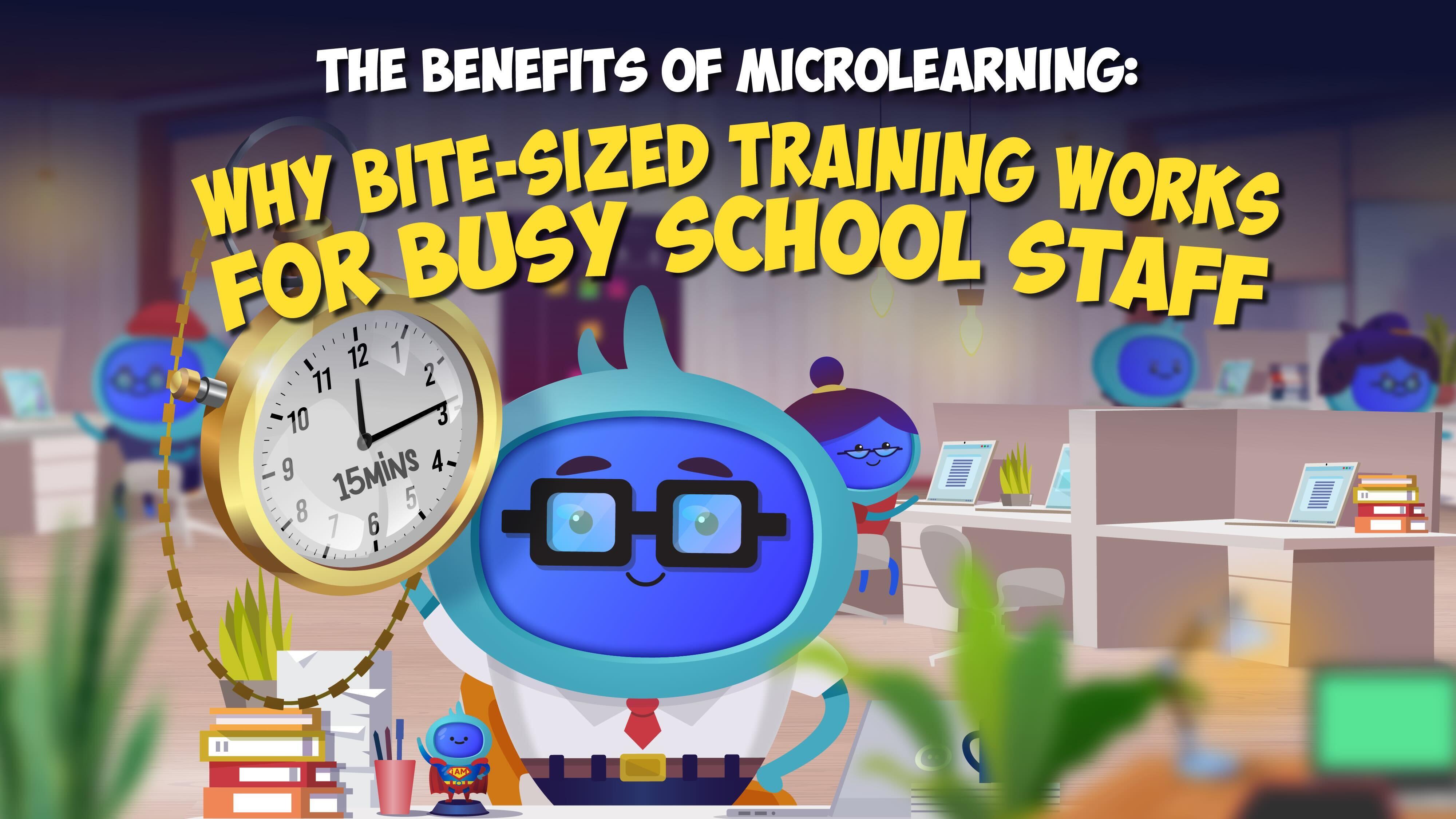
Finding time for staff training during a packed school week isn’t easy.
Full-day sessions can be difficult to organise, expensive to deliver and disruptive for everyone involved. Even when you manage to get the whole team in one room, there’s only so much information people can absorb before their attention begins to wander towards important emails, a pile of marking or those biscuits they have hidden in their cubby that they think no one knows about. We know, Barbara.
That’s where microlearning can help.
Microlearning delivers focused information in short, manageable courses, each designed around a clear subject or learning outcome. Instead of asking staff to process everything at once, it breaks learning down into useful chunks that can fit more easily around the school day.
A recent review of 40 studies found that well-designed microlearning can support outcomes such as knowledge, retention, application, engagement, motivation, and learner satisfaction. However, simply shortening a course doesn’t guarantee it’ll work. The content still needs to be relevant, engaging and properly designed.
So, what makes bite-sized learning particularly useful for schools and trusts?
1. It fits around the school day
School staff don’t have large gaps in their working week waiting to be filled with training.
Even for teacher training/inset days, there’s only so much you can get through. Staff often end up discussing timetable changes, new or revised school policies, or just catching up after holidays; they don’t have the hours to dedicate to all the training they might actually need.
Don’t forget, during working days, teachers have lessons, planning and marking. Support staff have pupils to help, records to update and a torrent of practical tasks. Leaders and business managers have approximately 3,510* things competing for their attention at any given moment.
Shorter courses are easier to complete around those responsibilities. Staff can learn at a suitable time without losing an entire day or abandoning their usual work.
This flexibility is especially useful across a MAT, where gathering everybody for the same face-to-face session can become a logistical challenge involving multiple sites, cover arrangements and an alarming number of calendars.
*May not be entirely accurate, but you get the point. It’s loads.
2. It keeps learning focused
Longer training isn’t automatically better training.
Sometimes, staff need a detailed programme covering a complicated subject. At other times, they need a clear explanation of a single issue, responsibility, or procedure.
Microlearning concentrates on what somebody genuinely needs to understand. It removes unnecessary background information and keeps each course centred on a specific outcome.
That could mean refreshing knowledge of allergy awareness, understanding a safeguarding responsibility or learning how to recognise a cybersecurity threat.
With microlearning, staff can get the information they need without searching through an hour-long course to find the five minutes that are relevant to them.
3. It reduces information overload
Give somebody too much information at once and important points can become lost among everything else.
Microlearning breaks complex subjects into smaller sections, giving learners a better chance to concentrate on one idea before moving to the next.
This doesn’t mean dumbing the subject down. It means structuring it carefully.
A complex topic can still be explored effectively through several short courses or modules. Each part builds on the last without expecting learners to absorb an enormous amount of information in a single sitting.
When the content is clear and focused, the learning feels more manageable too.
4. It makes important refreshers easier
Some workplace knowledge needs to be revisited regularly.
Staff may have completed training before but need a quick reminder of what to do in a particular situation. Perhaps guidance has changed, a responsibility has become relevant to their role, or they simply haven’t used that knowledge for a while.
A short refresher is often more practical than repeating a full-length course.
Microlearning can help schools respond quickly when staff need updated knowledge, whether that involves fire safety, data protection, safeguarding, first aid or another important area.
It gives people access to useful information at the point when they’re most likely to need and apply it.
5. It can keep learners engaged
Short courses have less opportunity to outstay their welcome, but length isn’t the only thing that matters.
A dull five-minute course is still a dull course.
Good microlearning combines focused content with elements that help people pay attention. That includes storytelling, realistic scenarios, animation, natural voiceover, decision-making activities, interactions and questions that check their understanding.
At iAM Academy, we use these elements to turn important workplace subjects into learning that feels relevant to school staff.
Instead of simply presenting a list of rules, we show how they apply in a recognisable situation. Learners can see the potential consequences of different choices and understand why the subject matters.
The aim isn’t just to get staff to the final screen, tick the ‘completed’ box and grab their certification. It’s to help them remember what they've learned when they need it.
6. It makes continuous development more manageable
Professional development shouldn’t be something that happens once a year during an inset day and is then forgotten.
Short, accessible courses make it easier for staff to keep building their knowledge throughout the year. Schools can assign training in response to changing priorities, individual roles or identified knowledge gaps.
Staff can also develop wider skills in areas such as leadership, communication, wellbeing and inclusion without needing to commit to a lengthy programme every time.
Over time, those smaller learning opportunities can help create a culture where development feels like a normal part of working life rather than a disruption.
Small courses can still make a big difference
Microlearning works best when it respects people’s time without cutting corners.
The course needs a clear purpose. The content needs to be accurate. And the learner should finish knowing something useful that they can apply in their role.
For busy schools and trusts, that balance matters.
iAM Academy includes more than 400 bite-sized courses covering safeguarding, Incidents, KCSIE, health and safety, compliance, leadership, wellbeing, SEND and wider professional development. Courses typically take between five and 30 minutes, making them easier to fit around the realities of school life.
If you already use iAM Compliant, upgrading to iAM Academy gives your organisation access to the complete course library, with learning that can be assigned and tracked across your school or trust.
Upgrade to iAM Academy today and discover how small courses can make a lasting impact.