You’ve likely already seen our training courses. If you have, we hope you’ve been wowed by the high-quality animation and impressed by the engaging storytelling. You’re probably pleased that you or your team now possess useful accreditation from CPD and/or IOSH, and that they’ve led to great outcomes and positive behavioural change.
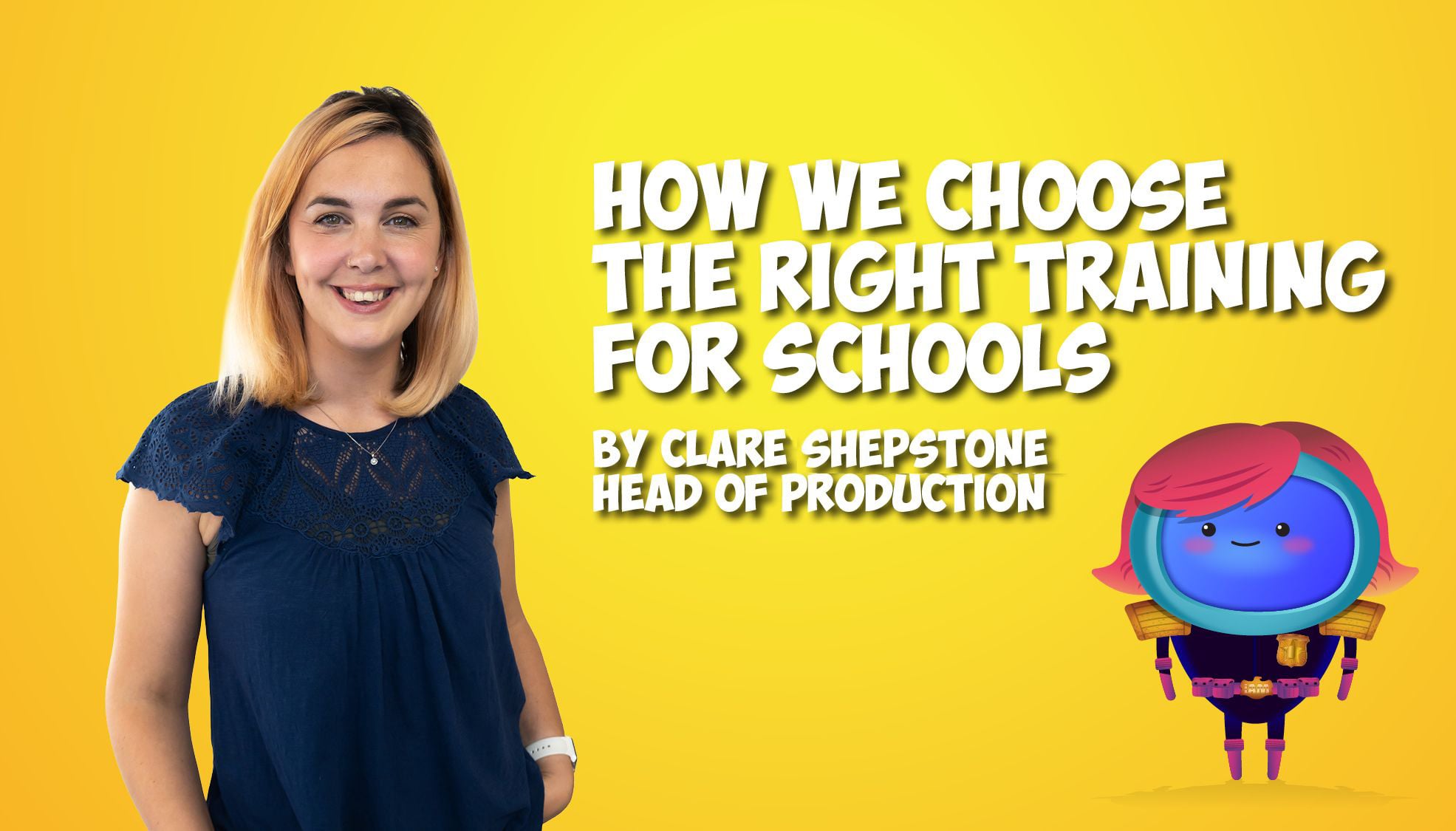
But some of you are also keen to find out how we choose the courses we write, what the process is, and more of the finer details. So, we asked our talented Head of Production, Clare Shepstone, to answer some of your most frequently asked questions. Read on to find out what goes on behind the scenes on the production side of iAM Compliant.
Q: How do you decide on the initial topic ideas for the courses?
A: Most of our early course ideas came from our directors, initially. They defined the set of health, safety and compliance topics to give us that strong foundation to build on.
These days, many of the ideas come from schools themselves. Feedback and requests are shared with us through the Customer Delight Team, mainly by our Head of Success, Steph Charlesworth and wider customer success team. Some requests are very specific to one school or setting, but when that happens, we may offer a bespoke course instead.
All suggestions feed into a central list. Each quarter, I review the list with Steph and Tom (Moore, COO). We look for gaps in our existing coverage and decide which topics are useful for a wider audience. If a topic meets that bar, it’s added to our course roadmap.
We also stay close to changes in government guidance and regulations. When something new comes up, we either create a new course or update an existing one.
Our roadmap is then shaped by capacity. We have a set number of build slots each month, based on the time and resource available. Because of that, we often plan well in advance. For example, our roadmap for 2026 is already full, and we’re now scheduling courses well into 2027.
Q: Do you sometimes agree on a course topic, but put it aside to make way for something more relevant and timely?
A: Yes, actually. For example, the recent topic of ‘Benedict’s law’ and the DoE publication of the allergy guidelines mean that we have moved our entire ‘Incidents’ collection forward in the course roadmap. They are more relevant, and schools are crying out for them in advance of the new school term in September. This does mean less ‘urgent’ ones have been pushed back, but we try to find a good balance. We’re already well into the process for the Incidents collection, so we’re confident they’ll be available in time for the Autumn term and teacher training days!
Q: When you decide to move topics in the roadmap, what does that decision-making process look like? Do you make that decision yourself, or with input from others?
A: Ultimately, the decision is mine as Head of Production, but I work closely with both the Sales and Customer Support teams. They are the ones getting questioned about upcoming legislation, so they know what customers’ priorities are. I wouldn’t just change the roadmap on a whim; it’s an informed decision from a collection of team leaders, dictated by customer need and upcoming legislation. We don’t take changing the roadmap lightly, because there is a lot to consider. For example, I also let the Marketing team know about changes, because they’ll be highlighting upcoming courses so customers know when to expect them (in time for the new term, in this case).
Q: What does the scoping process look like for your average course?
A: Typically, we’ll get a Subject Matter Expert (SME) [both in-house and external; we have a vast array of different skill sets and backgrounds here] to put together a research document for a subject. They’ll highlight what must be covered and link to useful research for our writing team. This document will be sent to an instructional designer to create a course scope, outlining learning objectives and suggesting how the course should be structured for the most engaging and useful learning experience. If the course is based on specific legislation, we’ll check it against that as well.
Q: Do all iAM Compliant’s courses go through a Subject Matter Expert? How do you find them?
A: No, they don’t all go through an SME, but it really depends on the topic. We tend to use SME’s for more technical subjects, such as Health & Safety or Compliance. And we always use them for school-specific topics such as SEND and Safeguarding. It makes sense because writers can’t be expected to know the intricate details of every subject, and any errors would be sent back to us for correction by the accrediting teams at CPD and IOSH. For soft skill courses, such as Mental Health and Psychological Safety, we might consult an SME, but for topics where we’re offering tips and techniques, we might not need to. As long as the research material is top-notch, anyway. We have quite a few internal SMEs available, with an array of experience, including former schoolteachers and specialists in their fields. It’s part of the hiring process to seek out those who bring something new to the team. You’d be astonished by the stuff these guys know! If we don’t have an SME for a topic internally, we might find them via our staff’s contacts (they usually have great recommendations) or through LinkedIn (or by meeting people at shows/events).
Q: Do you ever scope out a course, only to realise there isn’t enough content, and then scrap it?
A: Not really. We do scrap courses, but we usually don’t get beyond scoping them before realising there isn’t enough useful content. Or we might find that there’s too much crossover between two courses, and combine them into a larger one, or ‘bench’ a secondary one. In the past, we’ve ‘benched’ topics that weren’t as relevant, or no longer relevant because of some change in legislation, perhaps. We regularly review these at Roadmap meetings to see if ideas can be resurrected or adapted.
Q: Tell us about your creative sessions. Who is involved? Do you have one session that covers multiple topics, or more frequent sessions that cover one topic at a time?
A: It’s another ‘it depends’ answer, I’m afraid. We tend to get the whole team together for a creative session in the office, but occasionally they take the form of an impromptu ideas meeting over after-work drinks! During those ones, we might have to dial the ideas back a little (but we might find an absolute gem to polish). And they usually involve the writer, a storyboard artist, an animator (depending on the course) and me. Once a script is ready for scripting, we decide on themes or concepts to flesh out. One session might cover a whole collection of courses, or, if it’s a larger, more intricate course, we might have a separate meeting for it. After a course is written and approved, the design team will chat about how this might look in terms of characters and backgrounds.
At the moment, we’re heavily into creating content specifically for schools, so the graphics will likely be classroom-based. We try to come up with other things to make the course memorable (for example, the insects in the Sustainability courses). In other courses, we might go a little heavier on the theme, weaving in some dramatic storytelling to help aid memory. One session might cover a whole collection of courses, or, if it’s a larger, more intricate course, we might have a separate meeting for it.
Q: Who is responsible for the roadmap? How far ahead do you plan?
A: I’m solely responsible for the shaping and delivery of the roadmap, but it’s, of course, fed from colleague and customer input, rather than me arbitrarily putting things in place. I usually plan the upcoming year’s topics at budget time. We try to plan courses three months ahead of when we need them, just to give them a chance to get through production. It can be a long process, with all the quality checks, accreditation, etc. We’re relying on a wide range of people: experts, writers, artists, animators, voice actors, and course builders. All of whom are juggling multiple projects and have holidays, sickness and other things going on, obviously. For stability and planning, I’ll ‘freeze’ six months of the roadmap, so in those six months, we HAVE to deliver the courses on it, no swapping them around (except in circumstances where we absolutely must, in order that our customers get the best service).
A big thanks to Clare for taking the time out of her busy schedule to answer these questions.
Is there something you’d like to know about iAM Compliant? Please get in touch with us in the usual ways, and we’ll do our best to accommodate.
If you’d like to see any of these courses in action, you can find more than 400 of them in iAM Academy, available alongside the iAM Compliant system. Check it out today at: https://www.iamcompliant.com/iam-academy-training